Thursday, 6 April 2017

Tuesday, 4 April 2017
Paper no 5 Presentation
Sense & sensibility ppt from Drashti
click here to evaluate my presentation
Paper no 8 Assignment Hypermodernism
click here to evaluate my assignment
Name: Nagla Drashsti P.
Roll no: 9
Paper no : 8 Cultural Studies
Class: M.A : Sem-2
Year: 2016-2018
Enrollment no : 2059108420170021
E-mail address: nagladrashti38@gmail.com
Submitted: Smt S.B Gardy
Department of English Maharaja
Krishnakumarsinhji Bhavnagar
University,Bhavnagar.
Assignment topic: Hypermodernism
Hypermodernism is the cultural, artistic, literary and architectural successor to Modernism and Postmodernism in which the form (attribute) of an object has no context distinct from its function. Attributes can include shapes, colors, ratios, and even time. Unlike postmodernism and modernism, hypermodernism exists in an era of fault-tolerant technological change and treats extraneous attributes (most conspicuously physical form) as discordant with function. While modernism and post-modernism debate the value of the "box" or absolute reference point, hypermodernism focuses on improvising attributes of the box (reference point now an extraneous value rather than correct or incorrect value) so that all of its attributes are non-extraneous; it also excises attributes that are extraneous. Hypermodernism is not a debate over truth or untruth as per modernism/postmodernism; rather it is a debate over what is and is not an extraneous attribute. Synchrony between previously-clashing objects (now attributes) and amorphous self-identity coupled with allusions to a magical existence acknowledge the movement. Some theorists view hypermodernism as a form of resistance to traditional modernism; others as a supersedence of it.
Contents:
• 1Relationship to Modernism and Postmodernism
• 2Propelled by technological advances
• 3Non-composability of objects
• 4Long-term effects of Hypermodernism
• 5Hypermodernism and human psychology
• 6Artists
• 7Bibliography
Relationship to Modernism and Postmodernism
This section does not cite any sources. Please help improve this section by adding citations to reliable sources. Unsourced material may be challenged and removed. (March 2016) (Learn how and when to remove this template message)
Post-modernism and modernism debated each another in an industrial/physical context and were concerned with the social value of objects themselves. Modernism focused on confining form within the limited function of a 1950's object while 1970's postmodernism focused on freeing form from its limited function ("there-is-no-box"). The modern/postmodern oversight of objects as a mediator between attribute and function led to redundant human-context thinking and false conflicts between objects such as ideas.
Propelled by technological advances
This section does not cite any sources. Please help improve this section by adding citations to reliable sources. Unsourced material may be challenged and removed. (March 2016) (Learn how and when to remove this template message)
Technology has played a definitive role in function catching up to attribute. An example is the touch-screen in which the attribute on the screen (ratio, shape, color, animation) becomes the focus of interaction as opposed to manipulation by an external tool ie. cellphone keyboard. In the long-term the object ceases to become the middleman between attribute (form) and function.
Non-composability of objects
This section does not cite any sources. Please help improve this section by adding citations to reliable sources. Unsourced material may be challenged and removed. (March 2016) (Learn how and when to remove this template message)
Hypermodernism holds that an object is by definition non-composable toward its attributes; and no one attribute of an object can act as a proxy for the object itself. No whole, or object, is reducible to ONLY its attributes; and the attributes may not be mutually exclusive to the object itself. Furthermore, an object may have extraneous functions independent of its composing attributes (postmodern theory); this potential supra-functionality is a key concern to hypermodernism's attempt to replace objects with attributes. Attributes, while having the functions of an object, are not building blocks toward an object in hypermodernism. No object is by definition hypermodern; however, an object can be more hypermodern or less hypermodern than another object.
Long-term effects of Hypermodernism
This section does not cite any sources. Please help improve this section by adding citations to reliable sources. Unsourced material may be challenged and removed. (March 2016) (Learn how and when to remove this template message)
Hypermodernism displays a deep bias against objects physical and non-physical. It can be described as anti-object; however it is NOT anti-materialistic. Objects are viewed as an extraneous mediator between attribute and function. Over time, hypermodernism employs attributes to perform the functions of objects, and only those extant objects that can adequately convey the properties of its attributes are allowed to survive. Those objects that are irreducible to complete attributes will disappear as in the case of the physical keyboard. Over time, the attribute-function relationship becomes synonymous.
Hypermodernism and human psychology
This section does not cite any sources. Please help improve this section by adding citations to reliable sources. Unsourced material may be challenged and removed. (March 2016) (Learn how and when to remove this template message)
Hypermodernism compensates for the tendency of human thought to extract the attributes of an object and assign those same attributes to the functions of the object. Rather than focusing on a debate over "truth" or non-truth and other high-context social considerations, hypermodernism focuses on questions of extraneous vs non-extraneous (In design terms, correctness and incorrectness). Hypermodernism emphasizes correctness over completeness in design in order to guard against human intuitive leaps.
Artists
• Crudo [1][not in citation given
• Pete Ippel [2][3]
• Max Held [4]
• Martin Sjardijn [5][not in citation given]
• Djan Silveberg
Name: Nagla Drashsti P.
Roll no: 9
Paper no : 8 Cultural Studies
Class: M.A : Sem-2
Year: 2016-2018
Enrollment no : 2059108420170021
E-mail address: nagladrashti38@gmail.com
Submitted: Smt S.B Gardy
Department of English Maharaja
Krishnakumarsinhji Bhavnagar
University,Bhavnagar.
Assignment topic: Hypermodernism
 Hypermodernism:
Hypermodernism is the cultural, artistic, literary and architectural successor to Modernism and Postmodernism in which the form (attribute) of an object has no context distinct from its function. Attributes can include shapes, colors, ratios, and even time. Unlike postmodernism and modernism, hypermodernism exists in an era of fault-tolerant technological change and treats extraneous attributes (most conspicuously physical form) as discordant with function. While modernism and post-modernism debate the value of the "box" or absolute reference point, hypermodernism focuses on improvising attributes of the box (reference point now an extraneous value rather than correct or incorrect value) so that all of its attributes are non-extraneous; it also excises attributes that are extraneous. Hypermodernism is not a debate over truth or untruth as per modernism/postmodernism; rather it is a debate over what is and is not an extraneous attribute. Synchrony between previously-clashing objects (now attributes) and amorphous self-identity coupled with allusions to a magical existence acknowledge the movement. Some theorists view hypermodernism as a form of resistance to traditional modernism; others as a supersedence of it.
Contents:
• 1Relationship to Modernism and Postmodernism
• 2Propelled by technological advances
• 3Non-composability of objects
• 4Long-term effects of Hypermodernism
• 5Hypermodernism and human psychology
• 6Artists
• 7Bibliography
Relationship to Modernism and Postmodernism
This section does not cite any sources. Please help improve this section by adding citations to reliable sources. Unsourced material may be challenged and removed. (March 2016) (Learn how and when to remove this template message)
Post-modernism and modernism debated each another in an industrial/physical context and were concerned with the social value of objects themselves. Modernism focused on confining form within the limited function of a 1950's object while 1970's postmodernism focused on freeing form from its limited function ("there-is-no-box"). The modern/postmodern oversight of objects as a mediator between attribute and function led to redundant human-context thinking and false conflicts between objects such as ideas.
Propelled by technological advances
This section does not cite any sources. Please help improve this section by adding citations to reliable sources. Unsourced material may be challenged and removed. (March 2016) (Learn how and when to remove this template message)
Technology has played a definitive role in function catching up to attribute. An example is the touch-screen in which the attribute on the screen (ratio, shape, color, animation) becomes the focus of interaction as opposed to manipulation by an external tool ie. cellphone keyboard. In the long-term the object ceases to become the middleman between attribute (form) and function.
Non-composability of objects
This section does not cite any sources. Please help improve this section by adding citations to reliable sources. Unsourced material may be challenged and removed. (March 2016) (Learn how and when to remove this template message)
Hypermodernism holds that an object is by definition non-composable toward its attributes; and no one attribute of an object can act as a proxy for the object itself. No whole, or object, is reducible to ONLY its attributes; and the attributes may not be mutually exclusive to the object itself. Furthermore, an object may have extraneous functions independent of its composing attributes (postmodern theory); this potential supra-functionality is a key concern to hypermodernism's attempt to replace objects with attributes. Attributes, while having the functions of an object, are not building blocks toward an object in hypermodernism. No object is by definition hypermodern; however, an object can be more hypermodern or less hypermodern than another object.
Long-term effects of Hypermodernism
This section does not cite any sources. Please help improve this section by adding citations to reliable sources. Unsourced material may be challenged and removed. (March 2016) (Learn how and when to remove this template message)
Hypermodernism displays a deep bias against objects physical and non-physical. It can be described as anti-object; however it is NOT anti-materialistic. Objects are viewed as an extraneous mediator between attribute and function. Over time, hypermodernism employs attributes to perform the functions of objects, and only those extant objects that can adequately convey the properties of its attributes are allowed to survive. Those objects that are irreducible to complete attributes will disappear as in the case of the physical keyboard. Over time, the attribute-function relationship becomes synonymous.
Hypermodernism and human psychology
This section does not cite any sources. Please help improve this section by adding citations to reliable sources. Unsourced material may be challenged and removed. (March 2016) (Learn how and when to remove this template message)
Hypermodernism compensates for the tendency of human thought to extract the attributes of an object and assign those same attributes to the functions of the object. Rather than focusing on a debate over "truth" or non-truth and other high-context social considerations, hypermodernism focuses on questions of extraneous vs non-extraneous (In design terms, correctness and incorrectness). Hypermodernism emphasizes correctness over completeness in design in order to guard against human intuitive leaps.
Artists
• Crudo [1][not in citation given
• Pete Ippel [2][3]
• Max Held [4]
• Martin Sjardijn [5][not in citation given]
• Djan Silveberg
Paper no 7 Assignment Modernism and Postmodernism
click here to evaluate my assignment
Name: Nagla Drashsti P.Roll no: 9
Paper no : 7 Literary Theory and Criticism
Class: M.A : Sem-2
Year: 2016-2018
Enrollment no : 2059108420170021
E-mail address: nagladrashti38@gmail.com
Submitted: Smt S.B Gardy
Department of English Maharaja
Krishnakumarsinhji Bhavnagar
University,Bhavnagar.
Assignment Topic: Modernism and Postmodernnism
Modernism
What is Modernism?
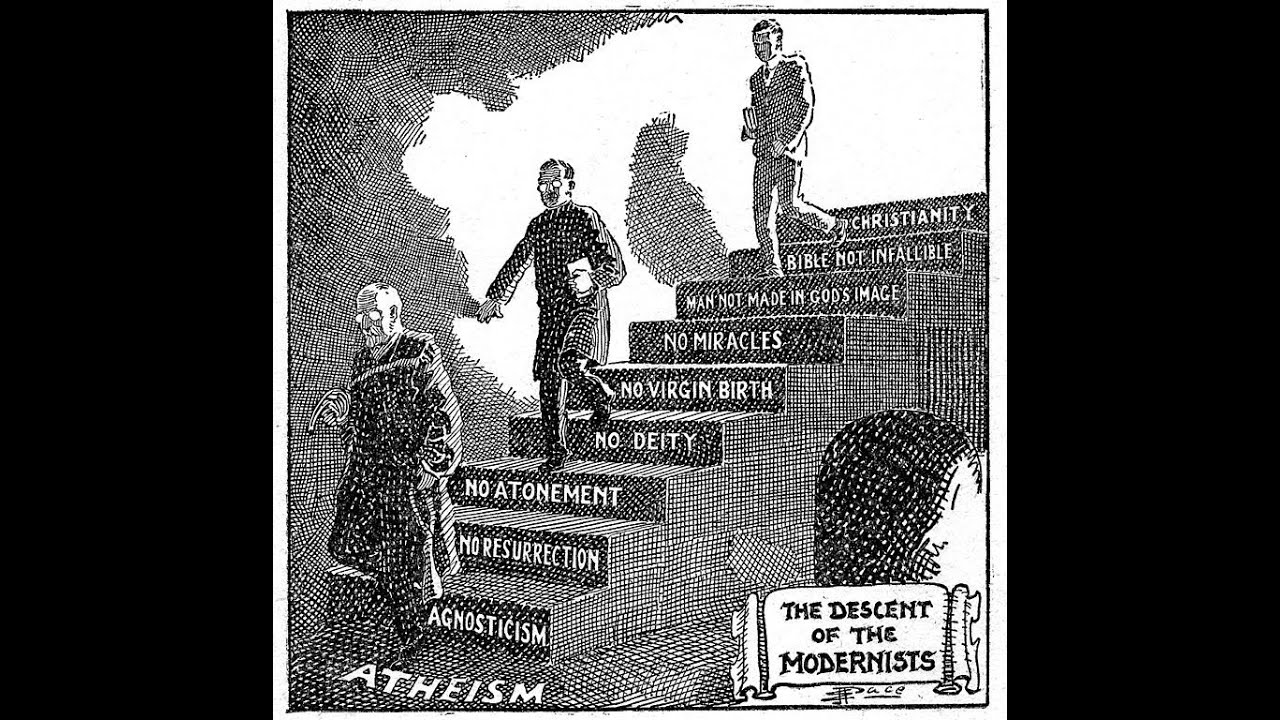
Modernism is notoriously difficult to define clearly because the term encompasses a variety of specific artistic and philosophical movements including symbolism, futurism, surrealism, expressionism, imagism, vorticism, dada, and others. To further complicate matters, many Modernists (including some of the most successful and most famous), are not affiliated with any of these groups.
However, there are some basic tenets of the Modernist period that apply, in one way or another, to all these movements and those writers and artists not associated with them: “Modernist literature is characterized chiefly by a rejection of 19th-century traditions and of their consensus between author and reader”. Specifically, Modernists deliberately tried to break away from the conventions of the Victorian era. This separation from 19th century literary and artistic principles is a major part of a broader goal. Modernists wished to distinguish themselves from virtually the entire history of art and literature. Ezra Pound captured the essence of Modernism with his famous dictum, “Make it new!” Many Modernist writers felt that every story that could possibly be told had, in one way or another, been told already. Therefore, in order to create something new, they often had to try using new forms of writing. The period thus produced many experimental and avant-garde styles. Perhaps best known for such experimentation are fiction writers James Joyce and Virginia Woolf, and poets T. S. Eliot and Ezra Pound, just to name a few.
When Was Modernism?
The dates of the Modernist movement (itself a problematic term, as there was in no sense a singular, consolidated, “movement”) are sometimes difficult to determine. The beginning of the 20th century is an extremely convenient starting point. It saw the end of Queen Victoria’s reign, marking a symbolic break from the preceding century. The turn of the century also roughly coincided with the publication of several groundbreaking theories, such as Freud’s Interpretation of Dreams and Einstein’s theory of special relativity. As such, there were real shifts (not merely symbolic changes) in the natural sciences, social sciences, and liberal arts occurring at this time as well. However, using the year 1900 as a starting point for Modernism is also problematic, as it would exclude some writers or texts from the late 1800s which definitively display Modernist tendencies. Many scholars thus use the year 1890 as a starting point; it is close to the end of Queen Victoria’s reign and the end of the century, but still fairly inclusive. It is important to remember, however, that while 1890 is an entirely appropriate starting date, it is also an artificial one.
By convention and convenience, most scholars use 1945 as the endpoint for Modernism. The date marks the end of WWII, and a momentous shift in world politics as well as in the most prominent social, cultural, and literary values. Personally, I prefer to use the year 1939 as a demarcation point. It is the beginning of WWII, and symbolically represents the same political and cultural changes brought about by the war as 1945 would represent. There is, however, a specific literary reason to use 1939 rather than 1945: it is the publication year of James Joyce’s Finnegans Wake. Insofar as Modernism is characterized chiefly by experimentation in structure, form, and technique, Finnegans Wake is the ultimate work of Modernism. It is truly the pinnacle of this experimentation and novelty. After the Wake, it is no longer possible for a writer to attempt to supersede his or her predecessors in the way Modernists often strove to do. As such, the Modernist movement had reached its natural teleological conclusion, and anything which came after must be part of a different part of literary history.
More on the Modernist Aesthetic:
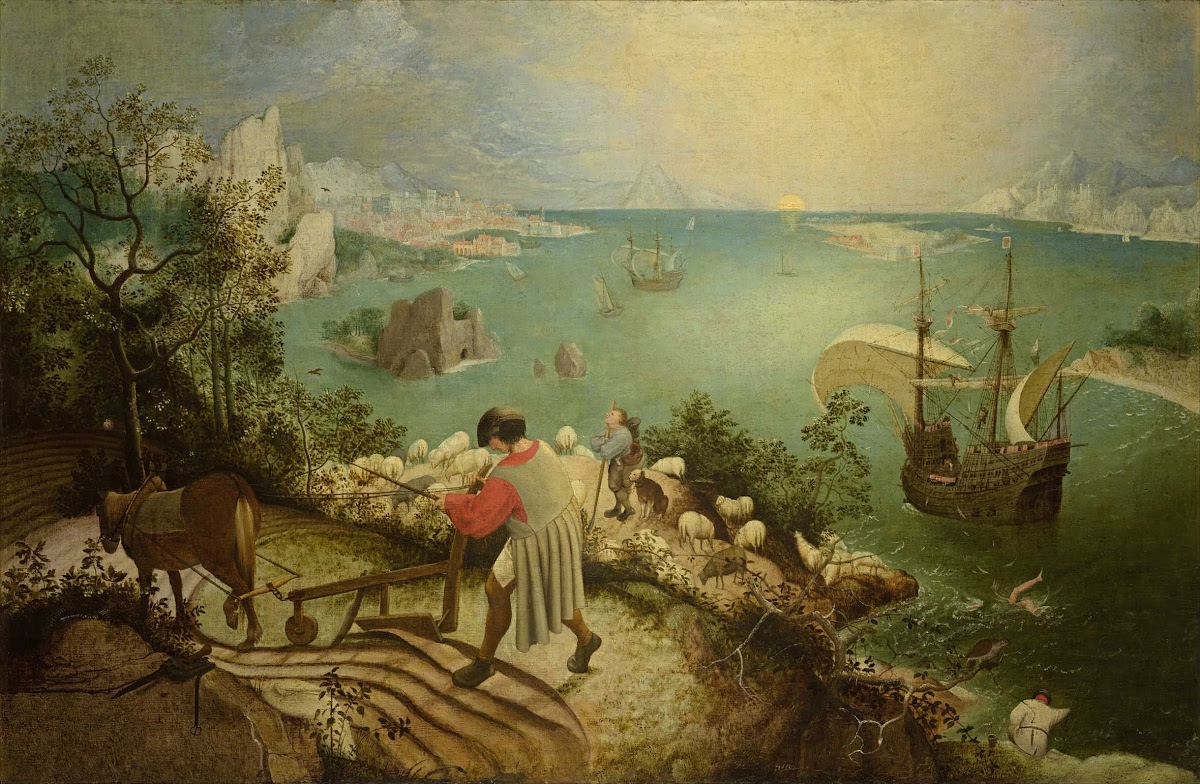
Pieter Bruegel the Elder (c. 1525 - 1569) - Landscape with the Fall of Icarus
Marcel Duchamp - Nude Descending a Staircase, No. 2 (1912)
The goal of accomplishing something which, artistically speaking, had never been done before was often accompanied by a sense of despair due to the inherent difficulty (and sometimes the apparent impossibility) of accomplishing that goal. This despair coincided with a changing worldview that filtered throughout British and much of European and American society. While the pre-Modernist world is characterized by sense of order and stability rooted in the meaningful nature of faith, collective social values, and a clear sense of identity (both personal and cultural), the Modernist period is characterized by a sense of chaotic instability rooted in the revelation that collective social values are not particularly meaningful, leading to faithlessness, skepticism, and a confused sense of identity. This worldview is prominent in much (though certainly not all) Modernist literature, perhaps most famously in the fragmented verse of T. S. Eliot’s The Waste Land.
An excellent visual depiction of this distinction between the pre-Modernist and Modernist ideology appears to the right. The painting at left is Bruegel's Landscape with the Fall of Icarus (the inspiration for W. H. Auden's poem "Musée des Beaux Arts"). Notice the clear imagery: the coastline with the seaside town; the shepherd with his dog and his flock; the plowman working his field; the ships, the sunset, and the flailing legs of the fallen Icarus. The images are clear, as is the classical allusion, and likely the message. Compare that to the painting at the right, Marcel Duchamp's Nude Descending a Staircase. Notice the fragmented imagery, the multiple perspective coalescing into a single view. If not for the title, many people would have no idea what the painting is supposed to depict. The clarity and order which characterize Bruegel's painting are entirely absent, replaced by a sense of chaos, confusion, and futility of meaning.
What is postmodernism? What are the Characteristics of Postmodern Literature?
Post-modernism
Post-modernism is the term used to suggest a reaction or response to modernism in the late twentieth century. So postmodernism can only be understood in relation to Modernism. At its core, Postmodernism rejects that which Modernism champions. While postmodernism seems very much like modernism in many ways, it differs from modernism in its attitudse toward a lot of these trends. Modernism, for example, tends to present a fragmented view of human subjectivity and history, but presents that fragmentation as something tragic, something to be lamented and mourned as a loss. Postmodernism, in contrast, doesn't lament the idea of fragmentation, provisionality, or incoherence, but rather celebrates that. In literature, it used to sdescribe certain characteristics of post–World War II literature, for example, on fragmentation, paradox, questionable narrators, etc. and a reaction against Enlightenment ideas implicit in Modernist literature.
Characteristics of Post-modernism:
Because of some similar characteristics of modernism and postmodernism, critics some time become confuse to differentiate one from the other. It would be more helpful if we discuss the characteristics of post-modernism in compare and contrast to modernism.
Like modernism, postmodernism also believes the view that there is no absolute truth and truth is relative. Postmodernism asserts that truth is not mirrored in human understanding of it, but is rather constructed as the mind tries to understand its own personal reality. So, facts and falsehood are interchangeable. For example, in classical work such as King Oedipus there is only one truth that is “obey your fate”. In contrast to classical work in postmodern work such as in Waiting for Godot, there is no such thing as absolute truth. All things are relative here.
Whereas Modernism places faith in the ideas, values, beliefs, culture, and norms of the West, Postmodernism rejects Western values and beliefs as only a small part of the human experience and often rejects such ideas, beliefs, culture, and norms.
Whereas Modernism attempts to reveal profound truths of experience and life, Postmodernism is suspicious of being "profound" because such ideas are based on one particular Western value systems.
Whereas Modernism attempts to find depth and interior meaning beneath the surface of objects and events, Postmodernism prefers to dwell on the exterior image and avoids drawing conclusions or suggesting underlying meanings associated with the interior of objects and events.
Whereas Modernism focused on central themes and a united vision in a particular piece of literature, Postmodernism sees human experience as unstable, internally contradictory, ambiguous, inconclusive, indeterminate, unfinished, fragmented, discontinuous, "jagged," with no one specific reality possible. Therefore, it focuses on a vision of a contradictory, fragmented, ambiguous, indeterminate, unfinished, "jagged" world.
Whereas Modern authors guide and control the reader’s response to their work, the Postmodern writer creates an "open" work in which the reader must supply his own connections, work out alternative meanings, and provide his own (unguided) interpretation.
Source: http://faculty.univ.edu
www.literary-articals.com
Paper no 6 Assignment Culture and Anarchy
click here to evaluate my assignment
Name: Nagla Drashsti P.
Roll no: 9
Paper no : 6 The Victorian Literature
Class: M.A : Sem-2
Year: 2016-2018
Enrollment no : 2059108420170021
E-mail address: nagladrashti38@gmail.com
Submitted: Smt S.B Gardy
Department of English Maharaja
Krishnakumarsinhji Bhavnagar
University,Bhavnagar.
Name: Nagla Drashsti P.
Roll no: 9
Paper no : 6 The Victorian Literature
Class: M.A : Sem-2
Year: 2016-2018
Enrollment no : 2059108420170021
E-mail address: nagladrashti38@gmail.com
Submitted: Smt S.B Gardy
Department of English Maharaja
Krishnakumarsinhji Bhavnagar
University,Bhavnagar.
Assignment Topic: Culture and Anarchy By Matthew
Arnold.
v Introduction:
In Culture and Anarchy,
Matthew Arnold sought a center of authority by which the anarchy caused by the
troubled passage of the Reform Bill of 1867 might be regulated. At its best,
his style is clear, flexible, and convincing. He wrote in such a complicated
mood of indignation, impatience, and fear, however, that his style and his
argumentative method are frequently repetitious and unsystematic. The book is
nevertheless a masterpiece of polished prose, in which urbane irony and shifts
of ridicule are used to persuade the Victorian middle class that it must reform
itself before it can begin to reform the entire nation.
Writing as a so-called Christian humanist, Arnold primarily
directed his criticism against the utilitarianism of the followers of Jeremy
Bentham and John Stuart Mill and against the various movements of liberal
reform. Disturbed by the social and political confusion, by Fenianism and the
Hyde Park Riots of 1866, and by the inability of either the church or the
government to cope with the growing unrest both in England and on the
Continent, Arnold attempted to describe an objective center of authority that
all, regardless of religious or social bias, could follow.
This center of authority is culture, which he defined on the
level of the individual as “a pursuit of our total perfection by means of
getting to know, on all matters which most concern us, the best which has been
thought and said in the world.” Because this authority is internal, it is a
study of perfection within the individual, a study that should elevate the
“best self” through a fresh and free search for beauty and intelligence. By
following “right reason,” the disinterested intellectual pursuits of the best
self, Arnold foresaw a way to overcome the social and political confusion of
the 1860’s and to prepare for a future in which all could be happy and free.
With this basically romantic view of human beings as a means and human
perfectibility as the end, Arnold turned to social criticism, carefully showing
that no other center of authority was tenable. The ideal of nonconformity, the
disestablishment of the church, led to confusion or anarchy because it
represented the sacrifice of all other sides of human personality to the
religious. The ideal of the liberal reformers, on the other hand, led to
anarchy because it regarded the reforms as ends rather than means toward a
harmonious totality of human existence.
Arnold clarifies his definition of culture by tracing its origin
to curiosity or “scientific passion” (the desire to see things as they really
are) and to morality or “social passion” (the desire to do good). Christianity,
as he saw it, is like culture in that it also seeks to learn the will of God
(human perfection) and make it prevail. Culture goes beyond religion, however,
as interpreted by the Nonconformists in that it is a harmonious expansion of
all human powers. In even sharper terms, culture is opposed to utilitarianism,
which Arnold considered “mechanical” because it worshiped means rather than
ends. In fact, anything—materialism, economic greatness, individual wealth,
bodily health, Puritanism—that was treated as an end except that of human
perfectibility was to Arnold mere “machinery” that led to anarchy. Only
culture, the harmonious union of poetry (the ideal of beauty) and religion (the
ideal of morality), sees itself as a means that preserves the totality of the
individual. Culture looks beyond machinery; it has only one passion—the passion
for “sweetness” (beauty) and “light” (intelligence) and the passion to make
them prevail. With such a passion it seeks to do away with social classes and
religious bias to make the best that has been thought and known in the world
(right reason) the core of human endeavor and institutions.
After establishing his definition of culture in terms of the
individual, Arnold turned toward the problem of society. He saw the
characteristic view of English people toward happiness as the individual
freedom, but he also saw that each class had its own opinion as to what it
considered freedom to be. In other words, there was a strong belief in freedom
but a weak belief in right reason, which should view freedom disinterestedly.
This misplacing of belief was to Arnold one of the chief causes of anarchy; it
was the mistake of acting before thinking. Ideally, right reason should precede
action, and the state should be the disinterested union of all classes, a
collective best self. In reality, the state was being led toward anarchy by
class interests because the aristocracy, or “Barbarians,” was inaccessible to
new, fresh ideas; the middle class, or “Philistines,
Plot and Major Characters
Although Arnold does not create specific fictional characters to
express his ideas in Culture
and Anarchy, he does infuse
his essays with a narrative persona that can best be described as a Socratic
figure. This sagacious mentor serves as a thematic link between each of the
chapters, underscoring the importance of self-knowledge in order to fully
engage the concept of pursuing human perfection. This mentor also identifies
and classifies three groups of people who comprise contemporary English
society. The first group is the Barbarians, or the aristocratic segment of
society who are so involved with their archaic traditions and gluttony that
they have lost touch with the rest of society for which they were once
responsible. The second group—for whom Arnold's persona reserves his most
scornful criticism—is the Philistines, or the selfish and materialistic middle
class who have been gulled into a torpid state of puritanical self-centeredness
by nonconforming religious sects. The third group is the Populace, or the
disenfranchised, poverty-stricken lower class who have been let down by the
negligent Barbarians and greedy Philistines. For Arnold, the Populace represents
the most malleable, and the most deserving, social class to be elevated out of
anarchy through the pursuit of culture.
Major Themes
Arnold introduces the principal themes of Culture and Anarchy directly in the essay's title. Culture
involves an active personal quest to forsake egocentricity, prejudice, and
narrow-mindedness and to embrace an equally balanced development of all human
talents in the pursuit of flawlessness. It is a process of self-discipline
which initiates a metamorphosis from self-interest to conscientiousness and an
enlightened understanding of one's singular obligation to an all-inclusive
utopian society. According to Stefan Collini, culture is “an ideal of human
life, a standard of excellence and fullness for the development of our capacities,
aesthetic, intellectual, and moral.” By contrast, anarchy represents the
absence of a guiding principle in one's life which prevents one from striving
to attain perfection. This lack of purpose manifests itself in such social and
religious defects as laissez faire commercialism and puritanical hypocrisy. For
Arnold, the myopic emphasis on egocentric self-assertion has a devastating
impact on providing for the needs of the community; indeed, it can only lead to
a future of increased anarchy as the rapidly evolving modern democracy secures
the enfranchisement of the middle and lower classes without instilling in them
the need for culture. Inherent in Arnold's argument is the idea of Hebraism
versus Hellenism. Hebraism represents the actions of people who are either
ignorant or resistant to the idea of culture. Hebraists subscribe to a strict,
narrow-minded method of moral conduct and self-control which does not allow
them to visualize a utopian future of belonging to an enlightened community.
Conversely, Hellenism signifies the open-minded, spontaneous exploration of
classical ideas and their application to contemporary society. Indeed, Arnold
believes that the ideals promulgated by such philosophers as Plato and Socrates
can help resolve the moral and ethical problems resulting from the bitter
conflict between society, politics, and religion in Victorian England. As
serious as Arnold's message is, he elects to employ the device of irony to
reveal his philosophical points to his readers. Through irony, satire, and
urbane humor, the author deftly entertains his readers with examples of
educational travesties, he wittily exposes the enemies of reform and culture,
and he beguiles his readers with self-deprecating humor in order to endear them
to his ideas.
Critical Reception
Since its publication in 1869, literary scholars have generally
regarded Culture and Anarchy as a masterpiece of social criticism.
While it is true that Arnold wrote his essay in response to specific Victorian
issues, commentators have since examined the work for its relevance to
universal ethical questions and social issues in subsequent generations.
Several twentieth-century critics have analyzed how Arnold employed the device
of social criticism to advocate his particular brand of humanism. William E.
Buckler has discussed Arnold's role as a classical moralist who believes that a
truly conscious approach to life is its own reward while also facilitating
personal growth. Other late-twentieth-century commentators such as Steven
Marcus, John Gross, and Samuel Lipman have all endorsed Arnold's relevance to
modern society with varying degrees of support. Marcus has asserted that the
philosophical ideas in Culture
and Anarchy resonate with
modern concerns about culture and education just as they did during the
author's time, pointing out that it is important to remember that a universal
standard of excellence exists to which all reformers, philosophers, and
critical thinkers should aspire. Lipman has added that “[there] can be little
doubt that Arnold's great value to us today is not as a philosopher of
community or of society, let alone of the state; his great value to us is as a
lonely spokesman for the individual's search for an inward culture.” Other
critics have challenged the claim that there is a timeless quality to Arnold's
humanistic philosophy. Maurice Cowling has questioned the ability of Arnold's
ideas to translate from the Victorian age to the modern day, particularly
noting that the religious politics are strikingly different between the two
periods. Vincent P. Pecora has examined Culture
and Anarchy in light of
Arnold's conspicuously absent thoughts on race relations as a factor in
elevating one's level of culture, concluding that it is a fundamental flaw that
cannot be ignored. Surveying the critical controversy surrounding Culture and Anarchy, Linda Ray Pratt has suggested that it
stems from misunderstanding Arnold. According to Pratt, “[the] tension between
Arnold's vocabulary, which has often taken on different connotations for
today's readers, and the basic humaneness of his of his social vision is one
reason for the confusion about his ideas
Paper no 5 Assignment The Gracian Urn
click here to evaluate my assignment
Name: Nagla Drashti P.
Roll no: 9
Paper no : 5 The Romantic Literature
Class: M.A : Sem-2
Year: 2016-2018
Enrollment no : 2059108420170021
E-mail address: nagladrashti38@gmail.com
Submitted: Smt S.B Gardy
Department of English Maharaja
Krishnakumarsinhji Bhavnagar
University,Bhavnagar.

Summary
In the first stanza, the speaker stands before an ancient Grecian urn and addresses it. He is preoccupied with its depiction of pictures frozen in time. It is the “still unravish’d bride of quietness,” the “foster-child of silence and slow time.” He also describes the urn as a “historian” that can tell a story. He wonders about the figures on the side of the urn and asks what legend they depict and from where they come. He looks at a picture that seems to depict a group of men pursuing a group of women and wonders what their story could be: “What mad pursuit? What struggle to escape? / What pipes and timbrels? What wild ecstasy?”
In the second stanza, the speaker looks at another picture on the urn, this time of a young man playing a pipe, lying with his lover beneath a glade of trees. The speaker says that the piper’s “unheard” melodies are sweeter than mortal melodies because they are unaffected by time. He tells the youth that, though he can never kiss his lover because he is frozen in time, he should not grieve, because her beauty will never fade. In the third stanza, he looks at the trees surrounding the lovers and feels happy that they will never shed their leaves. He is happy for the piper because his songs will be “for ever new,” and happy that the love of the boy and the girl will last forever, unlike mortal love, which lapses into “breathing human passion” and eventually vanishes, leaving behind only a “burning forehead, and a parching tongue.”
In the fourth stanza, the speaker examines another picture on the urn, this one of a group of villagers leading a heifer to be sacrificed. He wonders where they are going (“To what green altar, O mysterious priest...”) and from where they have come. He imagines their little town, empty of all its citizens, and tells it that its streets will “for evermore” be silent, for those who have left it, frozen on the urn, will never return. In the final stanza, the speaker again addresses the urn itself, saying that it, like Eternity, “doth tease us out of thought.” He thinks that when his generation is long dead, the urn will remain, telling future generations its enigmatic lesson: “Beauty is truth, truth beauty.” The speaker says that that is the only thing the urn knows and the only thing it needs to know.
Form
“Ode on a Grecian Urn” follows the same ode-stanza structure as the “Ode on Melancholy,” though it varies more the rhyme scheme of the last three lines of each stanza. Each of the five stanzas in “Grecian Urn” is ten lines long, metered in a relatively precise iambic pentameter, and divided into a two part rhyme scheme, the last three lines of which are variable. The first seven lines of each stanza follow an ABABCDE rhyme scheme, but the second occurrences of the CDE sounds do not follow the same order. In stanza one, lines seven through ten are rhymed DCE; in stanza two, CED; in stanzas three and four, CDE; and in stanza five, DCE, just as in stanza one. As in other odes (especially “Autumn” and “Melancholy”), the two-part rhyme scheme (the first part made of AB rhymes, the second of CDE rhymes) creates the sense of a two-part thematic structure as well. The first four lines of each stanza roughly define the subject of the stanza, and the last six roughly explicate or develop it. (As in other odes, this is only a general rule, true of some stanzas more than others; stanzas such as the fifth do not connect rhyme scheme and thematic structure closely at all.)
Themes
If the “Ode to a Nightingale” portrays Keats’s speaker’s engagement with the fluid expressiveness of music, the “Ode on a Grecian Urn” portrays his attempt to engage with the static immobility of sculpture. The Grecian urn, passed down through countless centuries to the time of the speaker’s viewing, exists outside of time in the human sense—it does not age, it does not die, and indeed it is alien to all such concepts. In the speaker’s meditation, this creates an intriguing paradox for the human figures carved into the side of the urn: They are free from time, but they are simultaneously frozen in time. They do not have to confront aging and death (their love is “for ever young”), but neither can they have experience (the youth can never kiss the maiden; the figures in the procession can never return to their homes).
The speaker attempts three times to engage with scenes carved into the urn; each time he asks different questions of it. In the first stanza, he examines the picture of the “mad pursuit” and wonders what actual story lies behind the picture: “What men or gods are these? What maidens loth?” Of course, the urn can never tell him the whos, whats, whens, and wheres of the stories it depicts, and the speaker is forced to abandon this line of questioning. In the second and third stanzas, he examines the picture of the piper playing to his lover beneath the trees. Here, the speaker tries to imagine what the experience of the figures on the urn must be like; he tries to identify with them. He is tempted by their escape from temporality and attracted to the eternal newness of the piper’s unheard song and the eternally unchanging beauty of his lover. He thinks that their love is “far above” all transient human passion, which, in its sexual expression, inevitably leads to an abatement of intensity—when passion is satisfied, all that remains is a wearied physicality: a sorrowful heart, a “burning forehead,” and a “parching tongue.” His recollection of these conditions seems to remind the speaker that he is inescapably subject to them, and he abandons his attempt to identify with the figures on the urn.
In the fourth stanza, the speaker attempts to think about the figures on the urn as though they were experiencing human time, imagining that their procession has an origin (the “little town”) and a destination (the “green altar”). But all he can think is that the town will forever be deserted: If these people have left their origin, they will never return to it. In this sense he confronts head-on the limits of static art; if it is impossible to learn from the urn the whos and wheres of the “real story” in the first stanza, it is impossible ever to know the origin and the destination of the figures on the urn in the fourth.
It is true that the speaker shows a certain kind of progress in his successive attempts to engage with the urn. His idle curiosity in the first attempt gives way to a more deeply felt identification in the second, and in the third, the speaker leaves his own concerns behind and thinks of the processional purely on its own terms, thinking of the “little town” with a real and generous feeling. But each attempt ultimately ends in failure. The third attempt fails simply because there is nothing more to say—once the speaker confronts the silence and eternal emptiness of the little town, he has reached the limit of static art; on this subject, at least, there is nothing more the urn can tell him.
In the final stanza, the speaker presents the conclusions drawn from his three attempts to engage with the urn. He is overwhelmed by its existence outside of temporal change, with its ability to “tease” him “out of thought / As doth eternity.” If human life is a succession of “hungry generations,” as the speaker suggests in “Nightingale,” the urn is a separate and self-contained world. It can be a “friend to man,” as the speaker says, but it cannot be mortal; the kind of aesthetic connection the speaker experiences with the urn is ultimately insufficient to human life.
The final two lines, in which the speaker imagines the urn speaking its message to mankind—”Beauty is truth, truth beauty,” have proved among the most difficult to interpret in the Keats canon. After the urn utters the enigmatic phrase “Beauty is truth, truth beauty,” no one can say for sure who “speaks” the conclusion, “that is all / Ye know on earth, and all ye need to know.” It could be the speaker addressing the urn, and it could be the urn addressing mankind. If it is the speaker addressing the urn, then it would seem to indicate his awareness of its limitations: The urn may not need to know anything beyond the equation of beauty and truth, but the complications of human life make it impossible for such a simple and self-contained phrase to express sufficiently anything about necessary human knowledge. If it is the urn addressing mankind, then the phrase has rather the weight of an important lesson, as though beyond all the complications of human life, all human beings need to know on earth is that beauty and truth are one and the same. It is largely a matter of personal interpretation which reading to accept.
Source: sparknotes.
Name: Nagla Drashti P.
Roll no: 9
Paper no : 5 The Romantic Literature
Class: M.A : Sem-2
Year: 2016-2018
Enrollment no : 2059108420170021
E-mail address: nagladrashti38@gmail.com
Submitted: Smt S.B Gardy
Department of English Maharaja
Krishnakumarsinhji Bhavnagar
University,Bhavnagar.
Assignment topic: The Gracian Urn
Ode on a Grecian Urn
Summary
In the first stanza, the speaker stands before an ancient Grecian urn and addresses it. He is preoccupied with its depiction of pictures frozen in time. It is the “still unravish’d bride of quietness,” the “foster-child of silence and slow time.” He also describes the urn as a “historian” that can tell a story. He wonders about the figures on the side of the urn and asks what legend they depict and from where they come. He looks at a picture that seems to depict a group of men pursuing a group of women and wonders what their story could be: “What mad pursuit? What struggle to escape? / What pipes and timbrels? What wild ecstasy?”
In the second stanza, the speaker looks at another picture on the urn, this time of a young man playing a pipe, lying with his lover beneath a glade of trees. The speaker says that the piper’s “unheard” melodies are sweeter than mortal melodies because they are unaffected by time. He tells the youth that, though he can never kiss his lover because he is frozen in time, he should not grieve, because her beauty will never fade. In the third stanza, he looks at the trees surrounding the lovers and feels happy that they will never shed their leaves. He is happy for the piper because his songs will be “for ever new,” and happy that the love of the boy and the girl will last forever, unlike mortal love, which lapses into “breathing human passion” and eventually vanishes, leaving behind only a “burning forehead, and a parching tongue.”
In the fourth stanza, the speaker examines another picture on the urn, this one of a group of villagers leading a heifer to be sacrificed. He wonders where they are going (“To what green altar, O mysterious priest...”) and from where they have come. He imagines their little town, empty of all its citizens, and tells it that its streets will “for evermore” be silent, for those who have left it, frozen on the urn, will never return. In the final stanza, the speaker again addresses the urn itself, saying that it, like Eternity, “doth tease us out of thought.” He thinks that when his generation is long dead, the urn will remain, telling future generations its enigmatic lesson: “Beauty is truth, truth beauty.” The speaker says that that is the only thing the urn knows and the only thing it needs to know.
Form
“Ode on a Grecian Urn” follows the same ode-stanza structure as the “Ode on Melancholy,” though it varies more the rhyme scheme of the last three lines of each stanza. Each of the five stanzas in “Grecian Urn” is ten lines long, metered in a relatively precise iambic pentameter, and divided into a two part rhyme scheme, the last three lines of which are variable. The first seven lines of each stanza follow an ABABCDE rhyme scheme, but the second occurrences of the CDE sounds do not follow the same order. In stanza one, lines seven through ten are rhymed DCE; in stanza two, CED; in stanzas three and four, CDE; and in stanza five, DCE, just as in stanza one. As in other odes (especially “Autumn” and “Melancholy”), the two-part rhyme scheme (the first part made of AB rhymes, the second of CDE rhymes) creates the sense of a two-part thematic structure as well. The first four lines of each stanza roughly define the subject of the stanza, and the last six roughly explicate or develop it. (As in other odes, this is only a general rule, true of some stanzas more than others; stanzas such as the fifth do not connect rhyme scheme and thematic structure closely at all.)
Themes
If the “Ode to a Nightingale” portrays Keats’s speaker’s engagement with the fluid expressiveness of music, the “Ode on a Grecian Urn” portrays his attempt to engage with the static immobility of sculpture. The Grecian urn, passed down through countless centuries to the time of the speaker’s viewing, exists outside of time in the human sense—it does not age, it does not die, and indeed it is alien to all such concepts. In the speaker’s meditation, this creates an intriguing paradox for the human figures carved into the side of the urn: They are free from time, but they are simultaneously frozen in time. They do not have to confront aging and death (their love is “for ever young”), but neither can they have experience (the youth can never kiss the maiden; the figures in the procession can never return to their homes).
The speaker attempts three times to engage with scenes carved into the urn; each time he asks different questions of it. In the first stanza, he examines the picture of the “mad pursuit” and wonders what actual story lies behind the picture: “What men or gods are these? What maidens loth?” Of course, the urn can never tell him the whos, whats, whens, and wheres of the stories it depicts, and the speaker is forced to abandon this line of questioning. In the second and third stanzas, he examines the picture of the piper playing to his lover beneath the trees. Here, the speaker tries to imagine what the experience of the figures on the urn must be like; he tries to identify with them. He is tempted by their escape from temporality and attracted to the eternal newness of the piper’s unheard song and the eternally unchanging beauty of his lover. He thinks that their love is “far above” all transient human passion, which, in its sexual expression, inevitably leads to an abatement of intensity—when passion is satisfied, all that remains is a wearied physicality: a sorrowful heart, a “burning forehead,” and a “parching tongue.” His recollection of these conditions seems to remind the speaker that he is inescapably subject to them, and he abandons his attempt to identify with the figures on the urn.
In the fourth stanza, the speaker attempts to think about the figures on the urn as though they were experiencing human time, imagining that their procession has an origin (the “little town”) and a destination (the “green altar”). But all he can think is that the town will forever be deserted: If these people have left their origin, they will never return to it. In this sense he confronts head-on the limits of static art; if it is impossible to learn from the urn the whos and wheres of the “real story” in the first stanza, it is impossible ever to know the origin and the destination of the figures on the urn in the fourth.
It is true that the speaker shows a certain kind of progress in his successive attempts to engage with the urn. His idle curiosity in the first attempt gives way to a more deeply felt identification in the second, and in the third, the speaker leaves his own concerns behind and thinks of the processional purely on its own terms, thinking of the “little town” with a real and generous feeling. But each attempt ultimately ends in failure. The third attempt fails simply because there is nothing more to say—once the speaker confronts the silence and eternal emptiness of the little town, he has reached the limit of static art; on this subject, at least, there is nothing more the urn can tell him.
In the final stanza, the speaker presents the conclusions drawn from his three attempts to engage with the urn. He is overwhelmed by its existence outside of temporal change, with its ability to “tease” him “out of thought / As doth eternity.” If human life is a succession of “hungry generations,” as the speaker suggests in “Nightingale,” the urn is a separate and self-contained world. It can be a “friend to man,” as the speaker says, but it cannot be mortal; the kind of aesthetic connection the speaker experiences with the urn is ultimately insufficient to human life.
The final two lines, in which the speaker imagines the urn speaking its message to mankind—”Beauty is truth, truth beauty,” have proved among the most difficult to interpret in the Keats canon. After the urn utters the enigmatic phrase “Beauty is truth, truth beauty,” no one can say for sure who “speaks” the conclusion, “that is all / Ye know on earth, and all ye need to know.” It could be the speaker addressing the urn, and it could be the urn addressing mankind. If it is the speaker addressing the urn, then it would seem to indicate his awareness of its limitations: The urn may not need to know anything beyond the equation of beauty and truth, but the complications of human life make it impossible for such a simple and self-contained phrase to express sufficiently anything about necessary human knowledge. If it is the urn addressing mankind, then the phrase has rather the weight of an important lesson, as though beyond all the complications of human life, all human beings need to know on earth is that beauty and truth are one and the same. It is largely a matter of personal interpretation which reading to accept.
Source: sparknotes.
Subscribe to:
Posts (Atom)
Paper no -15 Mass Communication and Media studies (Assignment)
To Evaluate my Assignment click here Name: Nagla Drashsti P. Roll no: 8 Paper no : 15 Mass Communication and Media studies...
