Roll
no: 8
Paper
no : 13 New Literature
Class:
M.A : Sem-4
Year:
2016-2018
Enrollment
no : 2059108420170021
E-mail
address: nagladrashti38@gmail.com
Submitted:
Smt S.B Gardy
Department
of English Maharaja
Krishnakumarsinhji
Bhavnagar
University,Bhavnagar.
Assignment topic: The Sense of
an Ending: Studies in the Theory of Fiction by Frank Kermode and Julian Barnes’s
adaption of the novel.
- Sense of an Ending by Frank Karmode:
The Sense of an Ending: Studies in the Theory of Fiction is the most famous work of the literary scholar Frank Kermode. It was first published in 1967 by Oxford University Press.
The book originated in the Mary Flexner Lectures, given at Bryn Mawr College in 1965 under the title 'The Long Perspectives'.
- About the Author Kermode:
After epigraphs from William Blake and Peter Porter, Kermode begins: "It is not expected of critics as it is of poets that they should help us to make sense of our lives; they are bound only to attempt the lesser feat of making sense of the ways in which we try to make sense of our lives." This is what he then sets out to do in the book.
Kermode claims that humans are deeply uncomfortable with the idea that our lives form only a short period in the history of the world. So much has gone before us and so much will come after us. We look for a 'coherent pattern' to explain this fact, and invest in the idea that we find ourselves in the middle of a story. In order to make sense of our lives we need to find some 'consonance' between the beginning, the middle, and the end.
Humans have always used such 'fictions' to impose structure on the idea of eternity, including Homer, Augustine of Hippo and Plato. Stemming from a long tradition of Christian apocalyptic thought, we now have the idea that the beginning was a golden age. The middle is the age in which we now live, and is characterized by 'decadence', where what was good has declined and is in need of 'renovation'. In order to usher in a new age, a process of painful purging (or 'terrors') needs to be undergone. This allows us to explain the chaos and 'crisis' we see unfolding around us.
People living in the middle often believe that the end is very near, and that their own generation is the one with responsibility to usher in a new world. Kermode writes:
'It seems to be a condition attaching to the exercise of thinking about the future that one should assume one's own time to stand in extraordinary relation to it.'
'Men in the middest' are also prone to make predictions about the date on which the world will end. These 'fictions' are not dangerous in themselves, but they should not be given the status of 'myth' and cause us to take unwarranted actions. Indeed, some people do approach apocalyptic fictions with a 'naive acceptance'. Others have a 'clerkly skepticism' and deny that it is possible to accurately predict the world's end date.
Stories of the end also allow individuals to reflect on their own death, and to make sense of their lives, their place in time, and their relationship to the beginning and the end. This gives rise to Kermode's memorable phrase: 'No longer imminent, the end is immanent.
Having laid down this theoretical position, Kermode tracks the creation of new attempts to 'make sense of life' through literature. He focuses on modern literature but covers a range of authors including William Shakespeare, Edmund Spenser, William Butler Yeats, T.S. Eliot, James Joyce, the French 'new novelists', William S. Burroughs, Samuel Beckett and Jean-Paul Sartre
In 2000 it was reissued with a new epilogue. Kermode's later work also continues similar trains of though
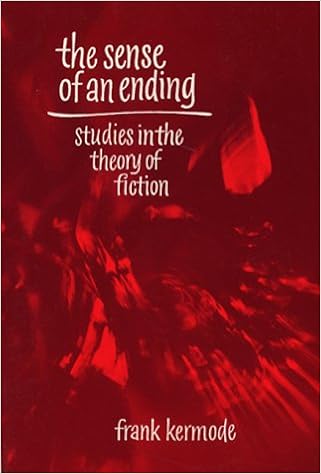
- About the Book:
On its publication, the book "caused considerable excitement among literary faculties in America". It is now considered important in the field of fiction theory.
In a 1967 review of the book, The New York Times described it as "impressively learned, eloquent and brilliant".
More recently The Daily Telegraph called it "magnificent", and Adam Phillips, in the London Review of Books, "one of the best books I had ever read".
Several obituaries of Kermode took the same title, including those that appeared in The Daily Telegraph and the journal Common Knowledge.
The book now appears on numerous university reading lists and is still regularly commented upon at academic conferences and in other books on literature.
Colin Burrow wrote in 2013 that he regarded it as one of “the three most inspiring works of literary criticism written in the twentieth century” together with Erich Auerbach's Mimesis and E.R. Curtius's European Literature and the Latin Middle Age.
- Adaptation of the novel Sense of an Ending by, Julian Barnes.
- The Sense of an Ending is a 2011 novel written by British author Julian Barnes. The book is Barnes' eleventh novel written under his own name (he has also written crime fiction under the pseudonym Dan Kavanagh) and was released on 4 August 2011 in the United Kingdom. The Sense of an Ending is narrated by a retired man named Tony Webster, who recalls how he and his clique met Adrian Finn at school and vowed to remain friends for life. When the past catches up with Tony, he reflects on the paths he and his friends have taken. In October 2011, The Sense of an Ending was awarded the Man Booker Prize. The following month it was nominated in the novels category at the Costa Book Awards.
- Publication:
The Sense of an Ending is Barnes' eleventh novel and was released in hardback on 4 August 2011. The Sense of an Ending is published by Random House (as a Jonathan Cape publication) in the United Kingdom. The book was released in October 2011 in the United States, after its previously-scheduled publication date for the United States was brought forward by three months by Random House's Knopf publishing group to capitalise on the short listing of the book as a candidate for the Booker prize. Suzanne Dean designed the cover for The Sense of an Ending. The cover shows floating dandelion seeds, with the edges of the page blackened.

- Title:
The title is borrowed from a book of the same name by Frank Kermode first published in 1967, subtitled Studies in the Theory of Fiction the stated aim of which is "making sense of the ways we try to make sense of our lives". Kermode's book is a well received piece of literary criticism. Critic Colin Burrow called it one of “the three most inspiring works of literary criticism written in the twentieth century”, comparing Kermode's work with Erich Auerbach's Mimesis and E.R. Curtius's European Literature and the Latin Middle Ages The critic Boyd Tonkin adds the additional interpretation that Barnes's “show-off” characters could be typical readers of Kermode's work.
- Synopsis:
The novel is divided into two parts, entitled "One" and "Two", both of which are narrated by Tony Webster when he is retired and living alone. The first part begins in the 1960s with four intellectually arrogant school friends, of whom two feature in the remainder of the story: Tony, the narrator, and Adrian, the most precociously intelligent of the four. Towards the end of their school days another boy at the school hangs himself, apparently after getting a girl pregnant. The four friends discuss the philosophical difficulty of knowing exactly what happened. Adrian goes to Cambridge University and Tony to Bristol University. Tony acquires a girlfriend, Veronica, at whose family home he spends an awkward weekend. On waking one morning he finds that he and Veronica's mother, Sarah, are alone in the house, and she apologizes for her family's behavior towards him. Tony and Veronica's relationship fails in some acrimony, as he breaks up with her after she has sex with him. In his final year at university Tony receives a letter from Adrian informing him that he is going out with Veronica. Tony replies to the letter, telling Adrian that in his opinion Veronica was damaged in some way and that he should talk to her mother about it. Some months later he is told that Adrian has committed suicide, leaving a note addressed to the coroner saying that the free person has a philosophical duty to examine the nature of their life, and may then choose to renounce it. Tony admires the reasoning. He briefly recounts the following uneventful forty years of his life until his sixties. At this point Tony's narration of the second part of the novel – which is twice as long as the first – begins, with the arrival of a lawyer's letter informing him that Veronica's mother has bequeathed him £500 and two documents. These lead him to re-establish contact with Veronica and after a number of meetings with her, to re-evaluate the story he has narrated in the first part. On consulting the lawyers, Tony learns that Veronica has Adrian's diary. This leads him to send Veronica repeated e-mails requesting the diary. Veronica eventually sends Tony a single page of the diary, containing Adrian's musings on life as a series of cumulative wagers. Following this, Veronica meets Tony on the Millennium Bridge in London and gives him the letter he sent to Adrian in his youth. On re-reading it, Tony realizes how malicious and unpleasant it was, and how he has erased this from his memory. Nevertheless, he persists in attempting to retrieve the diary from Veronica, which leads to her asking him to meet at a location in North London, where she drives him to see a group of mentally handicapped men being taken for a walk by their care worker, one of whom she points out to him. Tony does not understand the significance of this and Veronica leaves him with no explanation. Over the course of several weeks, Tony revisits the location until he is able to relocate the man Veronica showed him in a pub. Tony greets the man saying he is a friend of Veronica's which leads to an upset response from the man. Tony recalls the memory of Adrian from the man's facial features. He e-mails Veronica an apology, saying he didn't realize that she and Adrian had a son together. Veronica only responds with the reply "You don't get it, but then you never did." On revisiting the pub where he saw the man, Tony gets into conversation with the care worker, who reveals that the man is actually the son of Veronica's mother, Sarah, making him Veronica's brother
- Awards:
In September 2011, The Sense of an Ending was shortlisted for the Man Booker Prize. Barnes had been shortlisted for the prize on three previous occasions for Flaubert's Parrot (1984), England, England (1998) and Arthur & George (2005). On choosing The Sense of an Ending for the shortlist, judge Gaby Wood said "It seems to be the most obvious book on this list. It's a quiet book, but the shock that comes doesn't break stride with the tone of the rest of the book. In purely technical terms it is one of the most masterful things I've ever read." On 18 October 2011, The Sense of an Ending was awarded the Man Booker Prize. Head judge, Stella Rimington described the novel as "exquisitely written, subtly plotted and reveals new depths with each reading". She added "We thought it was a book that spoke to the humankind in the 21st Century."
On 15 November 2011, it was announced The Sense of an Ending had been nominated in the Best Novel category at the 2011 Costa Book Awards, though the book lost out to Andrew Miller's novel, Pure.
 Reference:
3. Singh,
Anita (18 October 2011). "Julian
Barnes wins the 2011 Man Booker Prize". The Daily Telegraph. Telegraph
Media Group. Retrieved 18 October 2011.
4. Singh,
Anita (18 October 2011). "Julian
Barnes wins the 2011 Man Booker Prize". The Daily Telegraph. Telegraph
Media Group. Retrieved 18 October 2011
5. Ellwood,
Pip (14 August 2011). "Julian
Barnes – The Sense of an Ending". Entertainment Focus. Retrieved 18
October 2011.


No comments:
Post a Comment